

*Creative work has been anonymized for client privacy


Higher Ed in the Trades | 2025
Higher Ed in the Trades | 2025
Simplifying Enrollment, Amplifying Results Through Customized Digital Experiences

Overview
A New York trade school wanted to reach more prospective students and improve enrollment strategy. The goal was to build awareness, sharpen audience targeting and create a more direct path to qualified leads.
Opportunity
The previous agency focused on remarketing, leveraging inconsistent static ad creatives and radio to attract potential students. There was a clear need to establish a firmer brand identity and expand marketing efforts to a larger, focused audience pool.
Narrowing Audience Focus for Direct Impact
By conducting extensive research using the school’s first-party data, as well as APIs to the U.S. Department of Labor and Education, we identified a student population primarily composed of younger adults from within New York State. These findings helped determine which channels to prioritize and how to reach students most likely to enroll.
Creating Opportunities for Success
Following initial discovery, a competitive media plan was developed. Seven immediate competitors in the New York metropolitan area and their marketing efforts became clear. These competitors maintain a consistent presence in the digital advertising landscape. The research identified six opportunities to reach prospective students and stand out from competing schools.
Competitive Landscape
To win in the competitive space, six opportunities were outlined.
- Prospective students are searching for various types of schools, including diesel mechanic, electrician, plumbing, motorcycle mechanic, HVAC, auto mechanic, welding, business management and engineering schools.
- Searches focused on programs and certifications, highlighting customer goals.
- Career pathways are a significant focus, with queries centering around “how to” become a mechanic, electrician, plumber or auto technician as well as general career training programs.
- Strong interest in different course formats, such as online courses, hands-on training and options for both part-time and full-time study.
- Location-based searches are prevalent, with many individuals looking for schools specifically in New York City, Queens and Long Island.
- Additional features that attract interest include affordable and approved trade schools as well as schools that offer job placement service.

Thinking Outside the Box(car)
Afternoon classes were underutilized, despite being a unique opportunity for working students. In reviewing potential causes for low attendance, transit accessibility was identified as a possible barrier for students balancing work and study. By utilizing New York City 2020 Census data, Boxcar Digital was able to determine demographic areas with high recruitment potential. These areas were then overlaid with relevant subway lines across New York City. Using these insights refined the digital campaign’s geographic targeting to boost afternoon enrollment.
Paid Media Engine
Paid Media Engine
Establishing the Apparatus
A mobile-first paid media strategy was designed to reach prospective students across digital channels and adapt as advertising platforms evolve. Creative and messaging were tested across audience segments to identify which combinations performed best against the school’s enrollment goals.
Media Plan
Media Plan
Establishing Timelines for Evergreen Success
The first priority upon accessing client ad accounts was optimizing the campaign setup for budget efficiency and ensuring the ability to adapt to changes in monthly enrollment. This led to the buildout of a program-based media structure, in which campaigns were set up in accordance with high-level campaign goals, in this case web leads, and then the subsequent adgroups were developed based on program and other client-prioritized marketing initiatives, such as instructor acquisition.
Design
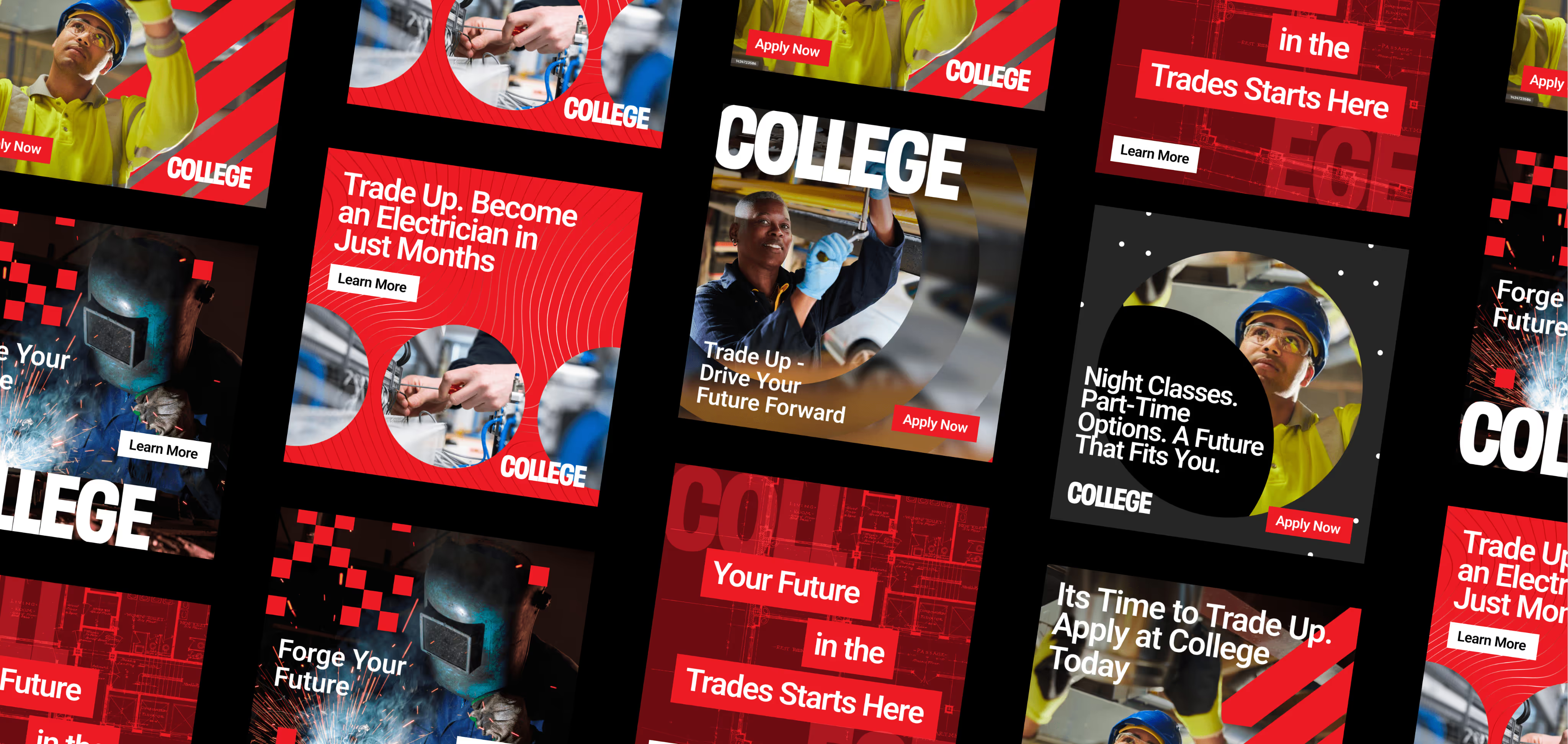
The creative delivered to the client provided significantly different creative concepts. To increase engagement and impact, bold colors, lifestyle images and graphic variations were chosen to highlight a variety of diverse messaging.
The design team chose the brand’s primary color to set the school apart from competitors and create a distinctive visual identity. Three ad creatives were designed to test in each program: one testimonial creative, another using the school’s logo mark as a window showcasing images of the trades, and a third design in the form of a wheel, also serving as a window to display trade-related imagery.
These ad designs maintain consistency across programs, with the images and copy changing to align with each specific program being promoted.
Website Development
Website Development
Maintaining Cohesion and an Engaging Experience
The landing page for the ad creative held equal importance to ensure a positive, consistent user experience. It uses the brand color scheme and creative assets from the advertisements to ensure a unified user experience.
Each landing page features similar elements to maximize conversions, like “Enroll Now” buttons, high-contrast headlines, compelling creative, and form submission inputs, creating a seamless connection between the ad and site design.
Deployment
Deployment
Deploy, Optimize, Review, Repeat
Following approvals, the campaign was ready to go live. We developed 214 advertising variations and 18 landing pages, so each program had space to tell its story and media spending could move toward the creative and student experiences that performed best. Web activations launched first, followed by Media Phase I and Phase II. In the first sixty days, total impressions rose 97% and clicks rose 51%.
From day one to present, real-time monitoring and optimizations take place, ranging from new keywords to adding, testing and deploying new conversion actions.


©2026 Boxcar Digital, the enrollment practice of Manhattan Strategies LLC

